
Estate History
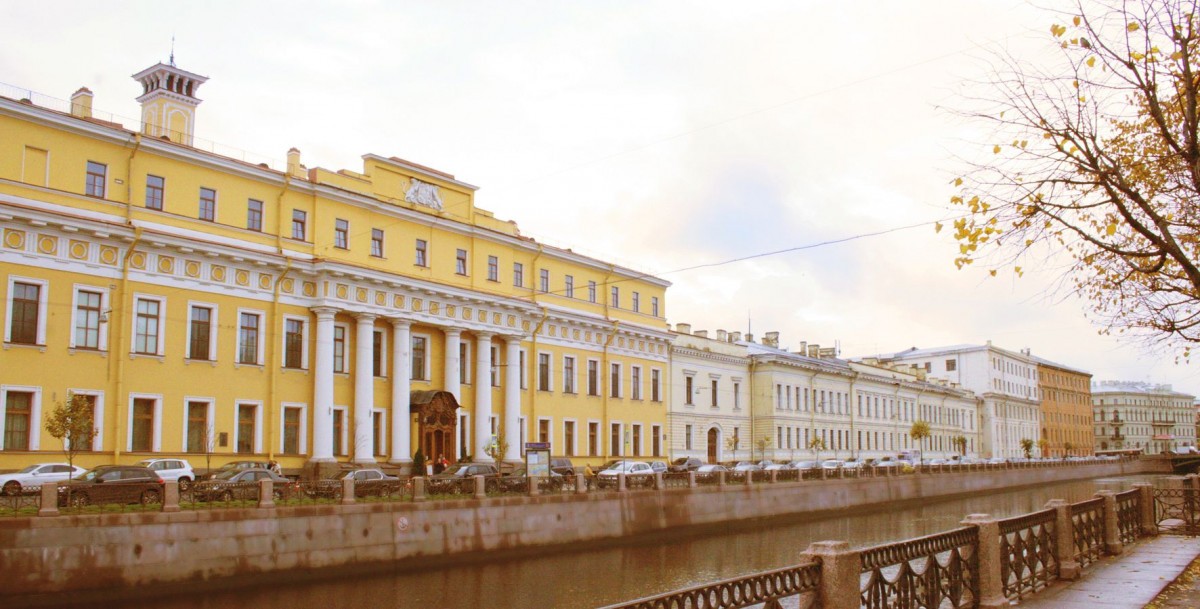
The facade of the Yusupov Palace on the Moika, regarded by contemporaries as one of the most elegant in St. Petersburg, conceals a historic city estate extending as far as Ofitserskaya Street, much like a theatrical curtain. Built in the 1770s by architect Jean-Baptiste Vallin de la Mothe for Count A. P. Shuvalov, the palace was considerably smaller than it is today. An archway cut through the centre of the facade, allowing carriages to enter the estate. Two service wings with utility courtyards stood on either side. The formal courtyard, with its colonnade and three gates, has survived almost unchanged, as has the Garden Pavilion at the far end of the grounds, rightly considered one of the oldest buildings on the estate.
After the death of Count A. P. Shuvalov, Empress Catherine II purchased the palace from his heirs for her lady-in-waiting, A. V. Branitskaya, and in 1795 granted it to her in perpetuity as hereditary property. In 1830, Alexandra Vasilyevna Branitskaya sold the house, together with all its furnishings, to the Yusupov princes for 250,000 roubles. Tatiana Vasilyevna Yusupova was Branitskaya's own sister, and the deed of sale was made out in the name of Boris Nikolaevich, Tatiana's only son from her marriage to N. B. Yusupov, the renowned dignitary, patron of the arts and collector of Catherine the Great's era. After his father's death in 1831, Prince Boris Nikolaevich settled in the new palace on the Moika with his mother and wife.
Beginning in 1832, a second storey was added above the eastern wing, which by then already extended as far as Ofitserskaya Street. Its richly decorated exhibition halls housed the collection brought from Arkhangelskoye. The ground floor contained kitchens, a coach house for ceremonial carriages, several sheds for everyday carriages, and stables with a hayloft. Opposite the carriage sheds, a single-storey outbuilding was erected, also containing stables and quarters for the grooms. Before long, however, the grooms were moved to the eastern wing, where apartments were arranged for the palace servants, while part of the wing was fitted out as a laundry and ironing room.
All horse-drawn vehicles entered the service courtyard through the gates from Glukhoi Lane. Beside the entrance was a gatekeeper's lodge, with the prince's ironing room next door.
To the right was the entrance for carts delivering food. This part of the eastern wing housed the kitchen facilities. The palace had several kitchens: one for the servants, a small kitchen in the main palace building and, finally, the Great Kitchen. This was the name given to the principal kitchen, where meals were prepared whenever the family was staying at the palace, as well as for formal dinners. Nearby were a confectionery kitchen, a washing-up room and a pantry with a small ice cellar for storing food.
The main icehouse, however, stood immediately to the left of the principal gates and was a wooden structure. Another ice cellar, this one underground, was built nearby, along with a wooden woodshed.
All these service buildings, together forming the service courtyard, were separated from the garden by a cast-iron railing set on a stone base. A similar railing enclosed the entire estate. It was only later, in the middle of the 19th century, that a stone wall was built between the neighbouring building of the Society of Military Cantonists and the Yusupov estate.
Pedestrians entered the estate from Ofitserskaya Street, where a second gatekeeper's lodge stood beside the coachmen's quarters. The wicket gate was opened at 7 a.m. and always locked at 7 p.m.
Yet the most idyllic corner of this vast estate was its old garden, which began immediately behind the palace and stretched all the way to Ofitserskaya Street.